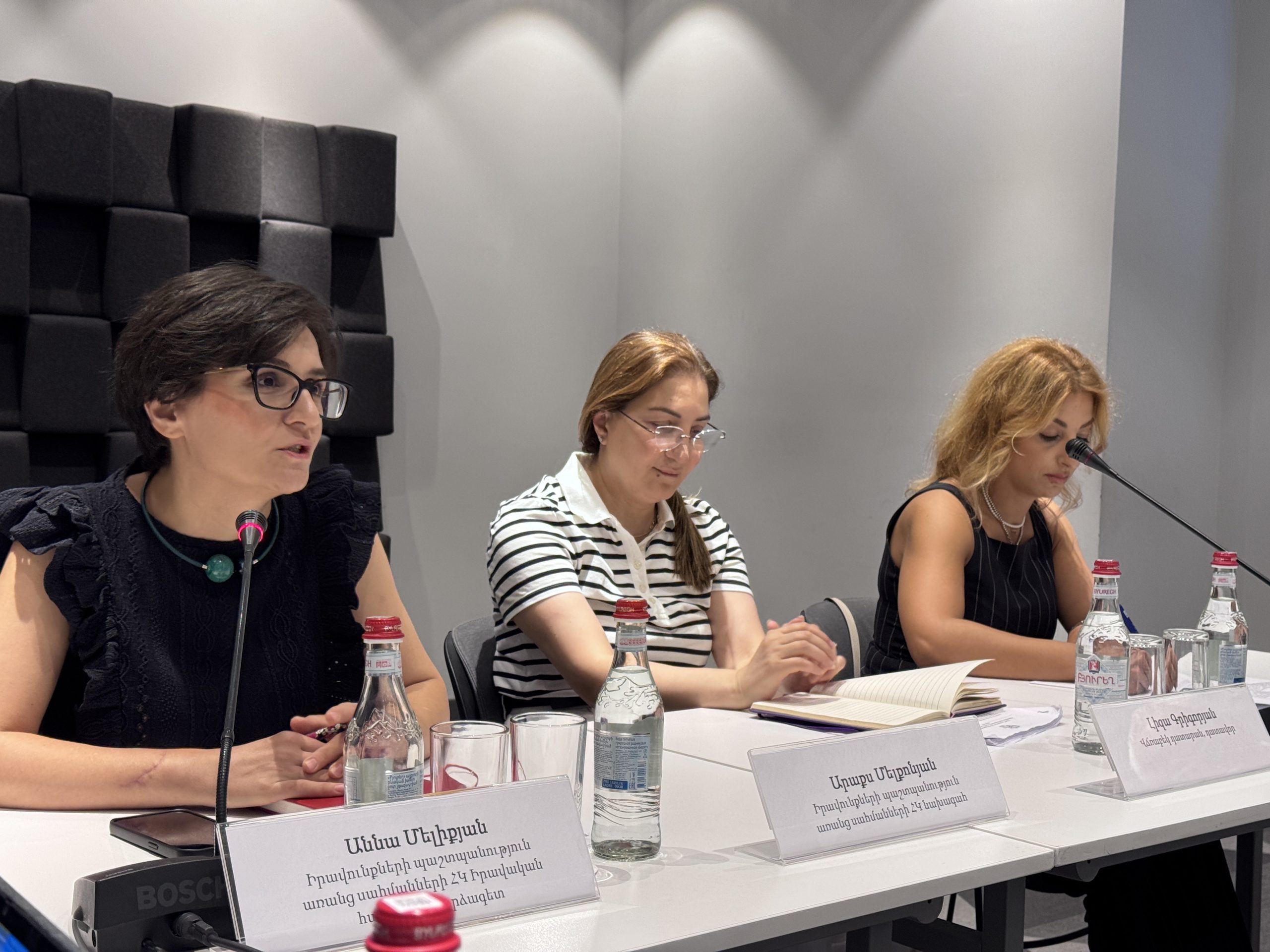
On August 26, the “Protection of Rights without Borders” (PRWB) NGO held a discussion entitled “Presentation of the Results of Monitoring Civil Proceedings Examined by the Anti-Corruption Court.”
The discussion presented the findings of monitoring conducted in 2025–2026 of proceedings concerning the confiscation of illegally acquired property and the protection of state and community interests before the Anti-Corruption Court.
In her opening remarks, PRWB President Araks Melkonyan noted that the study aimed to identify the specific features and challenges of the relevant legal regulations and their application in practice, particularly in light of the Constitutional Court’s decision of April 16, 2025.
Anna Melikyan, PRWB Program Coordinator and Legal Expert, presented a comparative analysis of judicial practice, examining the impact of the Constitutional Court’s decision ՍԴՈ-1776 on previously identified issues and its implications for the harmonization of legal practice.
One of the most significant changes following the Constitutional Court’s decision concerns the exclusion from confiscation proceedings of property acquired before a person assumed public office. Prior to the decision, the Prosecutor General’s Office included in confiscation claims property acquired after September 21, 1991, where its acquisition could not be justified by the person’s lawful income, regardless of when the person assumed office. Following the Constitutional Court’s decision in April 2025, the Prosecutor General’s Office has withdrawn claims, in whole or in part, in some cases. At the same time, questions remain as to whether the Prosecutor General’s Office is bound by the findings established during the pre-trial assessment and must limit its claim to the property identified therein, or whether it may amend the claim during court proceedings. There is currently no unified approach among the parties to the proceedings as to whether the grounds or subject matter of a claim may be amended during the trial, whether the amount of the claim may be increased, whether a new claim may be submitted or a new defendant added, and whether the statute of limitations applies in such cases.
Nina Hakobyan, PRWB Legal Researcher and Attorney, presented the findings of monitoring of cases brought before the Anti-Corruption Court by the Prosecutor’s Office for the protection of state and community interests. She noted that, given that many of the alleged violations or disputed transactions date back several years, a key issue in a significant number of cases is determining when the statute of limitations begins to run. Judicial approaches to this issue remain inconsistent.
Nina Hakobyan also highlighted divergent approaches to the application of the statute of limitations in cases concerning land plots that are not subject to alienation, emphasizing the need to clarify judicial practice and establish unified standards.
Liza Grigoryan, Judge of the Anti-Corruption Chamber of the Court of Cassation, and Narine Avagyan, Judge of the Anti-Corruption Court, shared their observations on the specifics and practice of examining anti-corruption civil cases.
The participants exchanged views on the practice of adjudicating anti-corruption cases in Armenia and discussed the challenges currently facing the field.
The study was conducted with the financial support of the National Endowment for Democracy (NED).