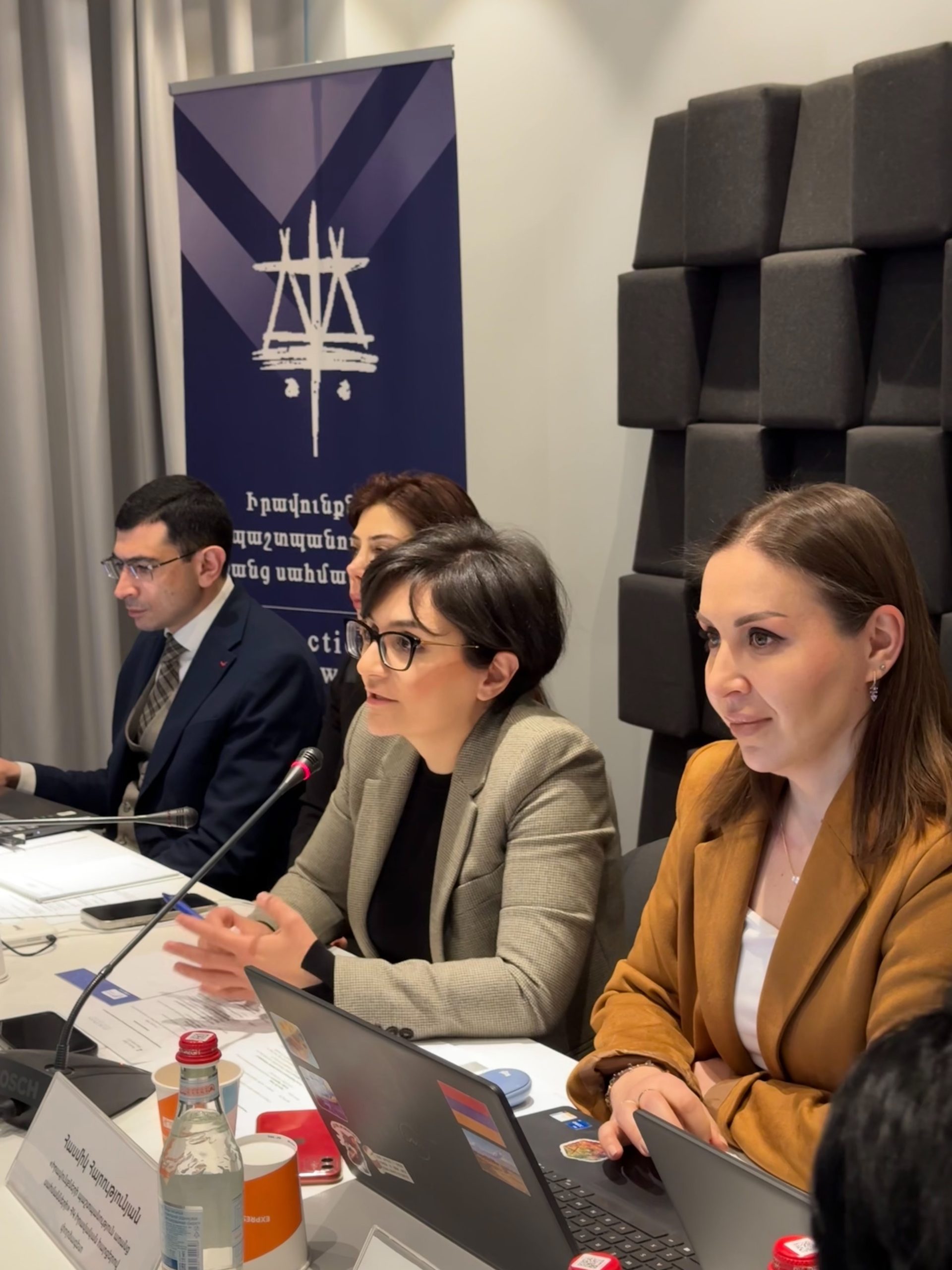
On April 30, the “Protection of Rights without Borders” NGO presented the findings of its study, “Overview of Disciplinary Proceedings Against Judges in 2025,” in Yerevan.
In her opening remarks, Araks Melkonyan, the President of the organization, emphasized that the NGO has, for years, consistently monitored and analyzed disciplinary proceedings involving judges. She noted that these processes where judicial accountability intersects with the protection of judicial independence and rights must remain subject to public scrutiny.
“It is essential to ensure a high level of protection of judges’ rights in order to safeguard the independent, impartial, and professional administration of justice grounded in the rule of law. At the same time, our studies over the years reveal a number of systemic issues in disciplinary practices that require comprehensive reform,” Melkonyan stated.
The study’s findings were presented by legal researcher Diana Harutyunyan and legal expert Hasmik Harutyunyan.
Diana Harutyunyan reported that, of the 17 disciplinary proceedings monitored, 11 were initiated by the Minister of Justice, five by the Ethics and Disciplinary Committee of the General Assembly of Judges, and one by the Corruption Prevention Committee.
“A significant portion of the proceedings concerned violations of procedural deadlines, undue delays in case handling, and breaches of judicial conduct rules. In several instances, violations of the fundamental right to a fair trial were also identified, particularly regarding the examination of cases within a reasonable time and the assurance of judicial impartiality,” she noted.
Hasmik Harutyunyan outlined both the procedural and substantive aspects of the review of disciplinary cases by the Supreme Judicial Council. According to her, the average number of hearings per case was three, and in several instances judges were represented by legal counsel. All but one of the proceedings were conducted publicly, with many attracting media attention.
She further noted that disciplinary liability was imposed in 10 of the 17 cases reviewed, while six petitions were rejected. Sanctions included reprimands, strict reprimands, warnings, and, in some cases, termination of judicial powers for serious disciplinary violations.
“The selection of sanctions was often not supported by sufficiently detailed legal reasoning or a consistent application of the principle of proportionality. Similar penalties were sometimes applied to violations of differing severity without adequate justification, and the consequences of such violations were not always thoroughly assessed, leading to inconsistencies in practice,” she emphasized.
Additional remarks were delivered by Yeranohi Tumanyants, a member of the Supreme Judicial Council, and Hovik Shahnazaryan, Chair of the Ethics and Disciplinary Committee of the General Assembly of Judges of the Republic of Armenia. They addressed key challenges in the field, current practices, and potential avenues for reform.
Judges, lawyers, state officials, international and diplomatic representatives, and civil society members attended the event and actively discussed the issues.
The presentation was held within the framework of the “Promoting the Independence of the Judicial System and Access to Justice” program, implemented with the support of the European Endowment for Democracy.