
Court Grants PRWB Beneficiary’s Claim for Early Old-Age Pension
Nina Hakobyan, a lawyer at the Protection of Rights without


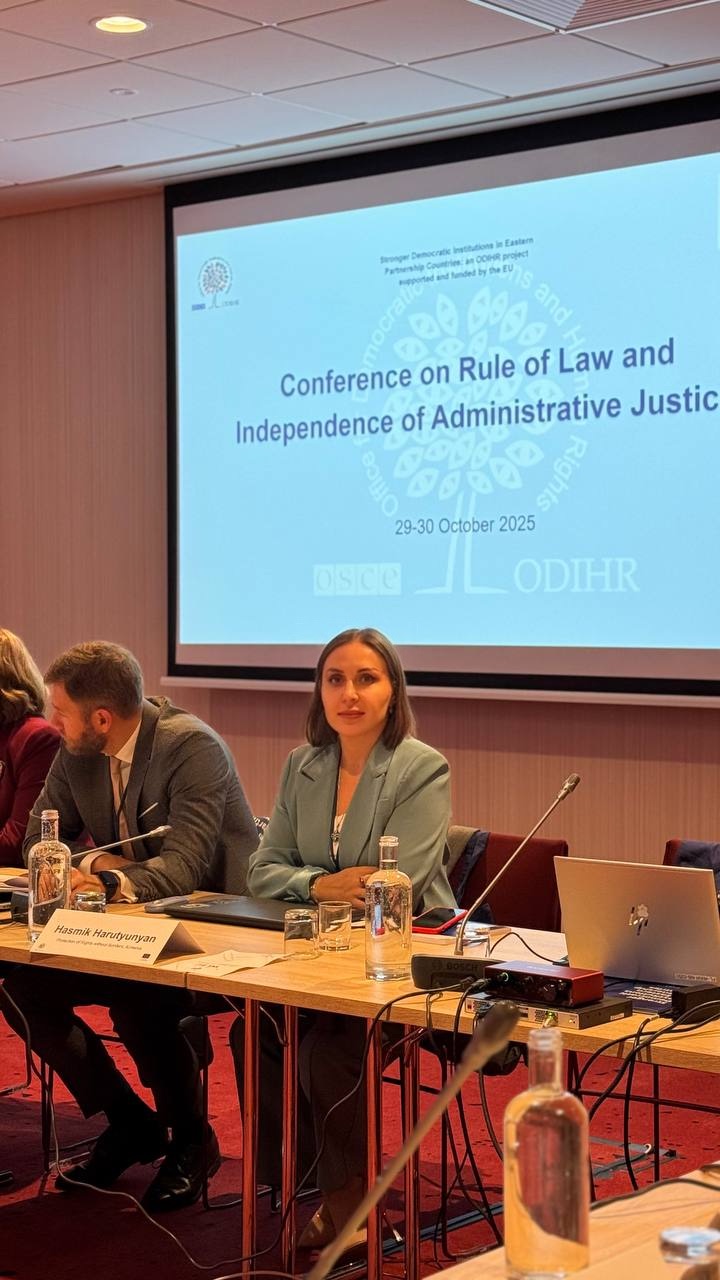
Hasmik Harutyunyan, legal expert at the Protection of Rights without Borders NGO, is participating in a conference on the Rule of Law and the Independence of Administrative Justice, organized by the OSCE ODIHR, taking place in Warsaw on October 29–30.
The two-day event is being held within the framework of the “Stronger Democratic Institutions in Eastern Partnership Countries” project.
Speaking at the panel discussion titled “Tools for Restoration of Public Trust to the Justice Sector Institutions”, Hasmik Harutyunyan presented the current state of judicial reforms in Armenia and the persisting challenges.
She noted that following the 2018 revolution, public expectations regarding the independence of the judiciary and systemic reforms were extremely high. However, the long-promised full vetting of judges was never carried out, and the disciplinary mechanisms introduced in its place have not ensured sufficient transparency or impartiality.
Harutyunyan stressed that despite certain legislative improvements, institutional safeguards that would protect judges from political influence remain incomplete, while merit-based appointment processes are still overshadowed by political considerations. Technical advancements, such as improvements in case management and electronic filing, have been useful, but they do not address the core systemic issues.
She underlined that restoring public trust in Armenia’s judicial system requires genuine and transparent integrity checks of judges and prosecutors, the elimination of political interference in appointments, stronger institutional protection for judges, enhanced transparency and public communication, and the development of an independent and equitable judicial culture.

Nina Hakobyan, a lawyer at the Protection of Rights without
On October 7–8, Anna Melikyan and Hasmik Harutyunyan, legal experts

The beneficiary of Nina Hakobyan, a lawyer at the Protection
On September 25, Hasmik Harutyunyan, Legal Expert at the “Protection