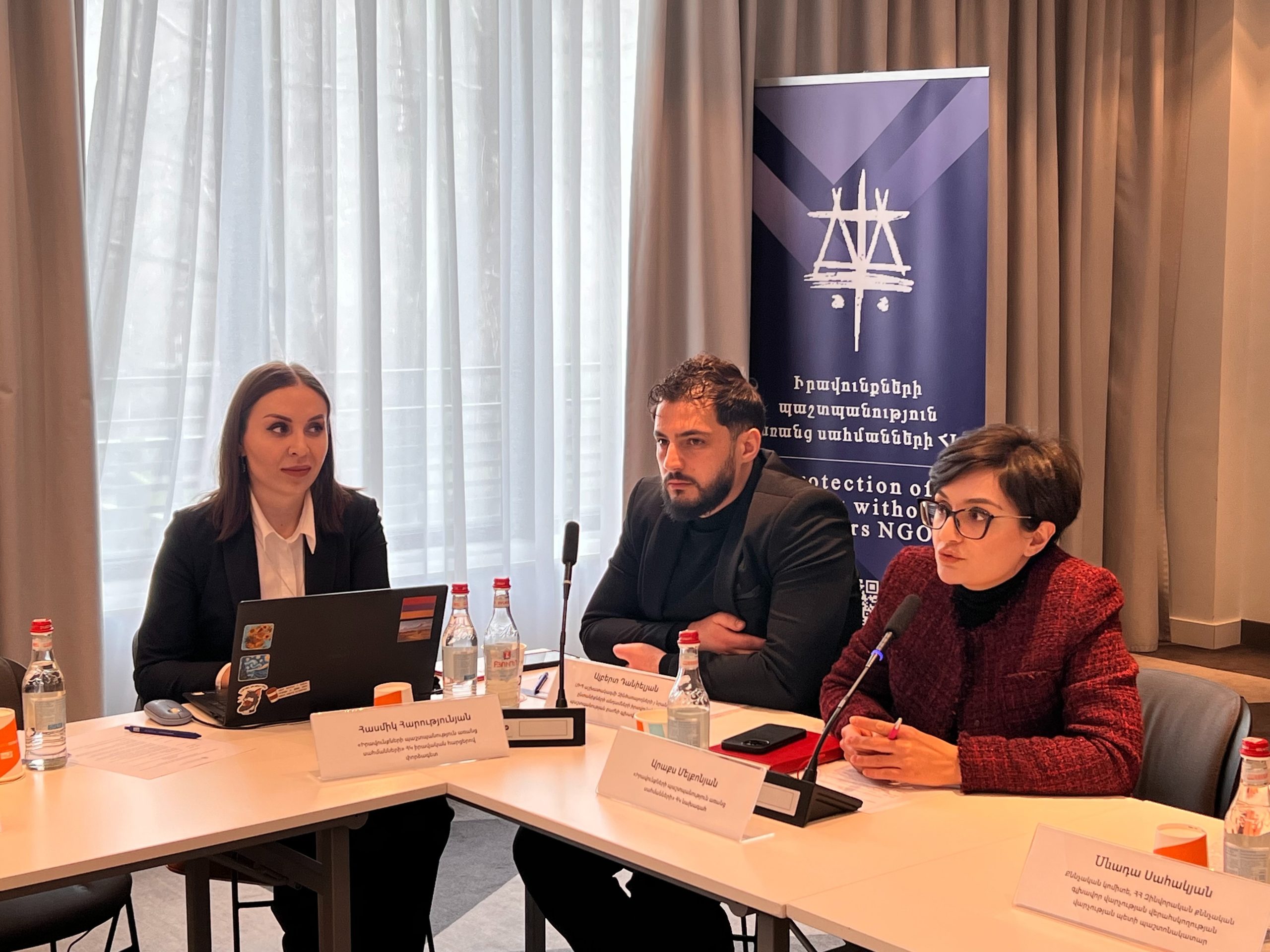
On March 31, the Protection of Rights without Borders (PRWB) NGO organized a discussion in Yerevan dedicated to presenting the results of a study on Judicial Practice in Cases of Violence and Ill-treatment in the Armed Forces of the Republic of Armenia.
In her welcoming remarks, PRWB President Araks Melkonyan emphasized the importance of protecting human rights within the armed forces, preventing violence, and ensuring effective investigations and fair trials.
“Given the absolute nature of the right to be free from ill-treatment, the state is obliged to ensure the protection of the dignity and human rights of servicemen under its direct control,” Melkonyan noted.
The main findings of the study were presented by the organization’s legal experts Anna Melikyan and Hasmik Harutyunyan.
As part of the study, 51 court cases involving 81 defendants were analyzed. These cases concerned acts under Articles 519–524 of the Criminal Code of the Republic of Armenia (formerly Articles 358, 358.1, 359–360, and 360.1 — 360.2 of the previous Criminal Code).
The analysis of the examined cases reveals several systemic issues. In particular, the comparative review shows that the primary causes of disputes and violence between servicemen include verbal insults and profanity, conflicts arising during the performance of official duties, minor бытовые disputes, violations of superior–subordinate relations, as well as instances of cruel treatment and psychological pressure.
The study also indicates that in certain cases the boundary between disciplinary and criminal liability remains unclear, especially when the act did not result in physical injury or other tangible consequences.
None of the reviewed cases resulted in an acquittal. One of the reasons is that most defendants requested expedited or plea-based proceedings, which imply an admission of guilt, while some cases ended with reconciliation between the parties. This practice limits the court’s ability to fully examine the circumstances of the case, does not sufficiently ensure the consideration of victims’ views, and may undermine both the purpose of justice and the deterrent effect of punishment.
In most cases where defendants were found guilty, courts imposed sentences of imprisonment that were subsequently suspended and replaced with probation. The sentences in the reviewed cases ranged from 15 days of detention to 8 years of imprisonment, while probation periods ranged from one to four years. Actual imprisonment was imposed only in cases involving incitement to suicide.
The discussion also featured remarks from Davit Navasardyan, Head of the Department for Supervision over the Investigation of Crimes against Military Service at the RA Prosecutor General’s Office; Sevada Sahakyan, Acting Head of the Supervision Department of the Main Military Investigation Department of the RA Investigative Committee; and Albert Danielyan, Chief Specialist at the Department for the Protection of the Rights of Servicemen and Their Family Members at the Office of the Human Rights Defender.
During the discussion, participants, including representatives of state institutions, human rights organizations, field experts, and other stakeholders shared their observations and proposals on improving the investigation of violence and ill-treatment cases in the armed forces and enhancing the effectiveness of judicial processes.
The discussion was held with the support of the European Endowment for Democracy (EED).